
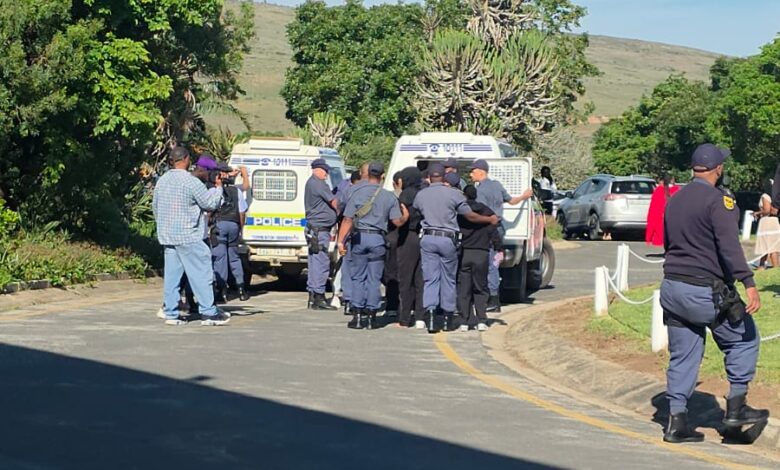
Thirteen protesters, predominantly Rhodes University students, have been arrested after Public Order Police (POP) fired rubber bullets and deployed stun grenades outside the 1820 Settlers National Monument in Makhanda, Eastern Cape, on Friday morning, 2 October.
The arrests come amid ongoing student opposition to the university’s 2027 student fee-payment protocol, which students argue could prevent financially disadvantaged individuals from continuing their studies.
Eastern Cape police spokesperson Captain Marius McCarthy confirmed the arrests to The Baseline, saying approximately 100 protesters gathered outside the graduation hall at around 08:30, where Rhodes University was holding its graduation ceremony.
According to McCarthy, the Operational Commander read a formal court order to the gathering at 08:38. The order, issued by the Eastern Cape High Court in Makhanda, prohibited protest action aimed at disrupting Friday’s graduation proceedings.
 01/05
Get seen where South Africa reads.
Homepage, category & newsletter placements.
02/05
Own the homepage. Just for a day.
Takeovers & sponsored placements, built to spec.
03/05
Don't wait for the 6 o'clock news.
Follow The Baseline on Facebook.
04/05
Straight to your phone. Before anyone else's.
Follow The Baseline on WhatsApp Channels.
05/05
News, refined.
No noise. Just the story.
Police said the protesters were given warnings and sufficient time to disperse peacefully but refused to comply with the order.
“Consequently, the Public Order Police moved in to clear the area, utilizing stun grenades and rubber bullets to manage the crowd,” McCarthy said in his response to The Baseline.
All 13 arrested protesters, aged between 19 and 23, have been charged with contravening a court order.
SAPS reported no serious injuries, although its response did not establish whether anyone sustained minor injuries during the police intervention.
Students dispute police account
However, students who witnessed Friday’s confrontation have challenged the police’s version of events.
Students claimed they had been sitting peacefully on the grass outside the monument when officers instructed them to leave within five minutes.
They disputed suggestions that they were obstructing access to the venue or attempting to enter the graduation hall, with some claiming police began dispersing the gathering after the five-minute warning expired.
Videos circulating on social media appeared to show students fleeing as smoke filled the area, while others were taken towards police vehicles.
The confrontation follows several days of tension between students and university management over proposed changes to the institution’s fee-payment arrangements.
What sparked the Rhodes University protests?
At the centre of the dispute is Rhodes University’s 2027 Protocol on the Payment of Student Fees, which introduces stricter payment requirements for students carrying historical debt.
Under the arrangements, returning self-funded undergraduate students with outstanding balances would be required to settle at least 50% of their debt before registration and commit to monthly payments of no less than R3,000 towards the remaining amount.
Students whose outstanding debt exceeds R25,000 would also face restrictions on residence admission unless they have confirmed National Student Financial Aid Scheme (NSFAS) funding.
The university’s Students’ Representative Council (SRC) has rejected the measures, arguing that they fail to adequately consider the socioeconomic circumstances of students who cannot afford the proposed payments.
The SRC also raised concerns about what it described as insufficient consultation with students before the protocol was introduced.
The dispute escalated earlier this week when students barricaded campus entrances, disrupting academic activities and access to university facilities.
Rhodes University has maintained that the revised payment arrangements are necessary to address its growing student debt and protect the institution’s financial sustainability.
High Court interdict and ongoing negotiations
Following the demonstrations, Rhodes University approached the Eastern Cape High Court in Makhanda, which granted an interim interdict on Wednesday, 30 September, restricting further protest action.
The matter is expected to return to court on 27 October.
The interdict followed disruptions to academic activities and concerns raised by university management over access to essential campus services.
Despite the court intervention, discussions between student representatives and the university executive have continued.
Earlier on Friday, the SRC had suspended its protest action following engagements with management, with both parties making progress on several issues raised in the students’ memorandum of demands.
Further discussions are expected next week, after which outstanding recommendations will be submitted to the university’s governance structures, including its council.
Friday morning’s confrontation at the graduation venue, however, saw police intervene and arrest 13 protesters.
McCarthy confirmed that Public Order Police would maintain their deployment at the monument to prevent further disruptions.
“Police will remain on high alert at the 1820 Settlers National Monument to ensure the graduation ceremony continues without further incident,” he said.
At the time of publication, SAPS had not specified when the arrested protesters would make their first court appearance or whether they would remain in custody pending their appearance.